5 min read · OSHA recordkeeping · Workplace safety
For many businesses, OSHA recordkeeping feels like one more compliance requirement.
Someone gets hurt. Someone fills out the paperwork. The injury goes on the OSHA 300 Log. At the end of the year, the numbers get summarized.
Done.
But if your business regularly has recordable injuries, I think you’re missing an opportunity if that’s all you’re doing with the information.
Your OSHA records aren’t just something OSHA may want to see. They’re telling you a story about what’s happening inside your business.
And if you know how to read that story, it can help you identify where people are getting hurt, why injuries keep happening, and what those injuries may really be costing you.
Start With Compliance
Let’s get the regulatory piece out of the way first.
Federal OSHA recordkeeping requirements are generally found in 29 CFR Part 1904. Depending on your size and industry, you may be required to maintain records of work-related injuries and illnesses.
The three forms you’re most likely to encounter are:
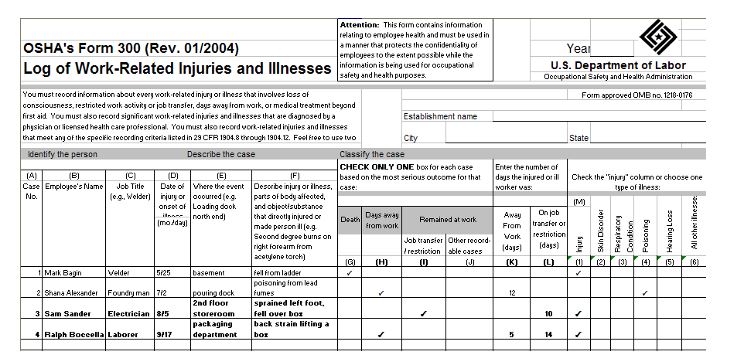
- OSHA Form 300 — Log of Work-Related Injuries and Illnesses
- OSHA Form 301 — Injury and Illness Incident Report
- OSHA Form 300A — Summary of Work-Related Injuries and Illnesses
Certain employers also have electronic reporting requirements.
And if you operate in a state with its own OSHA-approved State Plan, additional requirements may apply.
So yes, getting the recordkeeping right matters.
But that’s only the beginning.
Don’t Just Record the Injuries. Look for the Patterns.
Suppose you had eight OSHA-recordable injuries last year.
You can look at that and say:
“We had eight recordables.”
Okay.
But what does that actually tell you?
Not much.
I’d rather start asking questions.
Where did they happen?
What were the employees doing?
What type of injuries were they?
What time of day did they occur?
Which departments were involved?
How long had the injured employees worked for you?
Were supervisors involved in the investigation?
Were corrective actions identified?
Were those corrective actions actually completed?
Now we’re getting somewhere.
Maybe four of the eight injuries involved material handling.
That deserves attention.
Maybe five involved employees with less than 12 months of tenure.
Now I’m interested in your onboarding and training process.
Maybe three injuries occurred in the same department under the same supervisor.
That’s worth understanding.
Maybe you keep seeing slips and falls.
Housekeeping? Footwear? Flooring? Snow and ice procedures?
Frequency leaves fingerprints.
Your OSHA records can help you find them.
The Injury Isn’t Always the Real Problem
This is something I think businesses sometimes overlook.
A strained back is an injury.
But the injury may be the result of something else.
Poor material handling.
Inadequate training.
A rushed employee.
Bad workstation design.
Insufficient staffing.
A production incentive that unintentionally encourages shortcuts.
A supervisor who isn’t reinforcing safety expectations.
That’s why simply documenting an injury isn’t enough.
The objective should be to understand what allowed it to happen.
It’s the same reason a doctor doesn’t look at an MRI merely to confirm that your knee hurts.
The value is in figuring out why it hurts.
Your injury records can work the same way.
OSHA Recordables Can Affect More Than OSHA
There’s another reason I want businesses paying attention to these numbers.
Other people may be paying attention to them too.
Depending on your business, safety performance can become relevant to:
- Customers
- General contractors
- Insurance underwriters
- Risk-control professionals
- Prospective business partners
- Regulators
Some organizations evaluate contractors or vendors based partly on safety performance.
Insurance underwriters may also look at your injury experience when trying to understand the quality of the risk.
But here’s the important distinction:
A history of injuries is one thing. A history of injuries with no apparent response is something else entirely.
Suppose you’ve had a recurring problem with back injuries.
I’d much rather be able to tell an underwriter:
“We identified a pattern of material-handling injuries. We analyzed the tasks involved, changed the process, added equipment, retrained employees and supervisors, and we’ve had no similar injuries during the past 14 months.”
That’s a story.
It demonstrates that management understands its risks and responds to them.
That’s considerably different from:
“Yeah, we’ve had a lot of back injuries.”
Recordables Are Lagging Indicators
Your OSHA log tells you what already happened.
That’s useful.
But I’d also want to know what’s happening before somebody gets hurt.
Those are your leading indicators.
Things like:
- Near-miss reporting
- Safety observations
- Employee training
- Supervisor safety conversations
- Equipment inspections
- Corrective-action completion
- New-hire training
- Preventive maintenance
- Job hazard analyses
- Safety meetings
Your recordable injury rate tells you something about yesterday.
Those activities can tell you something about tomorrow.
That’s where I’d rather spend our energy.
And Then There’s the Cost
An OSHA-recordable injury isn’t simply a number on a log.
Think about what happens when an employee gets hurt.
Production may stop.
A supervisor gets involved.
Someone investigates.
Paperwork gets completed.
The employee receives medical treatment.
A workers’ compensation claim may be filed.
Someone else may have to cover the injured employee’s work.
Overtime may increase.
Production may slow.
Training may be required.
Management gets involved.
Maybe the employee can’t return to his or her regular job immediately.
Perhaps the injury ultimately affects your workers’ compensation experience modification factor.
There are costs that show up on an insurance loss run.
And there are costs that never do.
That’s why I think OSHA recordkeeping belongs in a larger conversation about Total Cost of Risk (TCOR).
Insurance premium is one cost of risk.
So are injuries.
As are deductibles.
And overtime.
Plus downtime.
Don’t forget lost productivity.
And employee turnover.
What about damaged equipment?
Oh, and regulatory penalties.
And so is the management time required to deal with all of it.
If all we’re doing is recording the injury and moving on, we aren’t managing the cost.
We’re documenting it.
Don’t Chase the Number
There’s one caution here.
The objective shouldn’t simply be:
“We need fewer OSHA recordables.”
That’s the outcome we want, but pursuing the number itself can create the wrong incentives.
We don’t want employees afraid to report injuries.
We don’t want supervisors discouraging reporting because they’re being evaluated on recordable rates.
And we certainly don’t want legitimate injuries swept under the rug.
I’d rather focus on:
Why are people getting hurt, and what can we change?
Do that well and the numbers should follow.
Here Are the Questions I’d Ask
If your company has regular OSHA-recordable injuries, sit down with your management team and look at the last three years.
Don’t just count the injuries.
Ask:
What patterns do we see?
Which departments?
Which jobs?
Which types of injuries?
Which supervisors?
New employees or experienced employees?
What days and times?
What equipment?
What activities?
What happened after each injury?
Was there an investigation?
Root cause identified?
Corrective action assigned?
Was it completed?
And then ask the most important question:
Are we seeing injuries today that look remarkably similar to injuries we’ve already had?
If the answer is yes, you may have found a significant opportunity.
This Is What Risk Management Should Look Like
Your OSHA 300 Log isn’t a safety program.
It isn’t going to prevent an injury.
And it certainly isn’t a strategy.
It’s information.
What matters is what you do with it.
At Morton Insurance & Risk Management, this is the kind of distinction we think matters.
We don’t simply want to know how many claims you’ve had or what your insurance premium costs.
We want to understand what’s driving those costs.
Where are the patterns?
What’s within your control?
What can be improved?
What would make employees safer?
What would make your organization a better risk?
And how could those improvements ultimately affect your Total Cost of Risk and the way insurance companies view your business?
That’s the difference between simply buying insurance and developing a risk-management strategy.
So yes, keep your OSHA records because you’re required to.
But don’t stop there.
Read them.
They may be telling you exactly where to start.